Bloomington Urban Forestry Research Group
Indiana University Bloomington

Recent News

A promotional flyer for an FFA E-Learning Hour event titled "The Environmental Impact of Redlining," featuring speaker Dr. Burnell Fischer on Thursday, January 15, 2026, at 11 AM. The graphic includes a description of the Indianapolis-focused MLK Day session alongside an image of a grassy field, a tree, and a QR code to register.

January 2026 Burney Fischer presents “Redlining in Indy and the Environmental Impacts” to Future Farmers of America e-learning hour

The Future Farmers of America (FFA) national office conducts a monthly FFA e-learning hour for its staff and members.  A FFA communications specialist who previously invited Burney to give his presentation “Redlining in Indy and the Environmental Impacts” to a INDYGO Lunch & Learn (see BURFG In the News, April 2025) re-connected with him to present “The Environmental Impact of Redlining” for the FFA e-learning hour on January 15.  The presentation generated multiple questions and was a fun learning experience for all.

December 2025- Fischer's guest lecture - E555- Sustaining Urban Ecosystems

Burney Fischer was filmed for a guest lecture and subsequent discussion with instructor Gwen White on urban patch dynamics and related topics for the O’Neil SPEA E555 course Sustaining Urban Ecosystems to be taught asynchronously for the spring 2026 semester.  A three-page pre-session description of patch dynamics and a few associated articles are the prework for the students.  The presentation covers introductory thinking about urban patches – from both a social (neighborhoods) and ecological (urban forested patches) perspective.  The presentation closes with a review of redlining and the Moxley and Fischer research paper “Historic HOLC Redlining in Indianapolis and the Legacy of Environmental Impacts.”  The Fischer/White discussion focuses on redlining and its ecological and social-ecological impacts on cities and as well as how urban greening nonprofits might address this long-standing legacy to improve the environmental condition and human health of those living in impacted areas. 

Two side-by-side maps of Indianapolis labeled (a) and (b) display color-coded historical redlining zones. Map (a) shows numerous brown square data points concentrated primarily in the central urban area, while map (b) displays a small cluster of black star icons in the southwestern red zone.
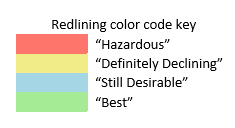
A redlining color code key with four colored blocks corresponding to neighborhood classifications: red for "Hazardous", yellow for "Definitely Declining", light blue for "Still Desirable", and green for "Best".

May 2025- Fischer presents “Redlining in Indy and the Environmental Impacts” to INDYGO Lunch & Learn Session

The Indianapolis Public Transportation Corporation, branded as IndyGo, is a public transit agency and municipal corporation of the City of Indianapolis. It operates fixed-route buses, bus rapid transit, micro transit and paratransit service. They conduct an in-house “Lunch & Learn” series for their employees on topics of local interest. Someone found the Moxley/Fischer (2020) paper – “Historic HOLC Redlining in Indianapolis and the Legacy of Environmental Impacts” and contacted Burney about making an INDYGO Zoom presentation on Earth Day, April 22. The session was attended by over 30 individuals and was recorded and will be posted for others to watch. The presentation generated multiple questions and was a fun learning experience for all.

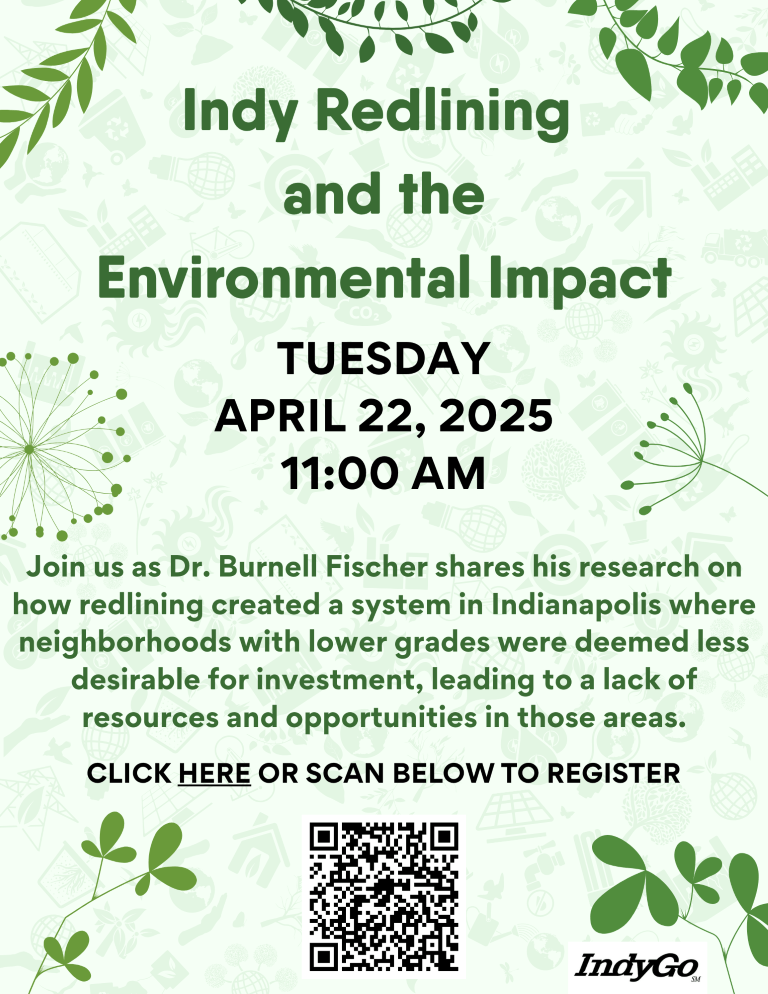
An IndyGo event flyer titled "Indy Redlining and the Environmental Impact" is scheduled for Tuesday, April 22, 2025, at 11:00 AM featuring speaker Dr. Burnell Fischer. The graphic outlines a presentation on how redlining restricted investment and resources in Indianapolis neighborhoods and provides a QR code for registration.

April 2025- BUFRG Co-leader, Dr. Sarah Mincey, is now Chair of the Indiana Community Forestry Council

The Indiana Community Forestry Council (IN-CFC) recently announced that Mincey will be their next chair. As they shared in their newsletter, “Her community-based vision and environmental governance expertise will guide us forward. As the founder of Canopy Bloomington, Sarah brings a wealth of experience in education, academia, research, program administration, and nonprofit leadership. Her professional passion is social-ecological systems, and we are confident that her leadership will continue to advance our mission and strengthen Indiana's community forests”.

The IN-CFC serves in an advisory capacity to the state’s Community and Urban Forestry program and is essential in allowing the state of Indiana to receive federal pass-through dollars for urban forestry projects. The newsletter can be accessed here- please scroll down to read the story about Dr. Mincey’s new role.

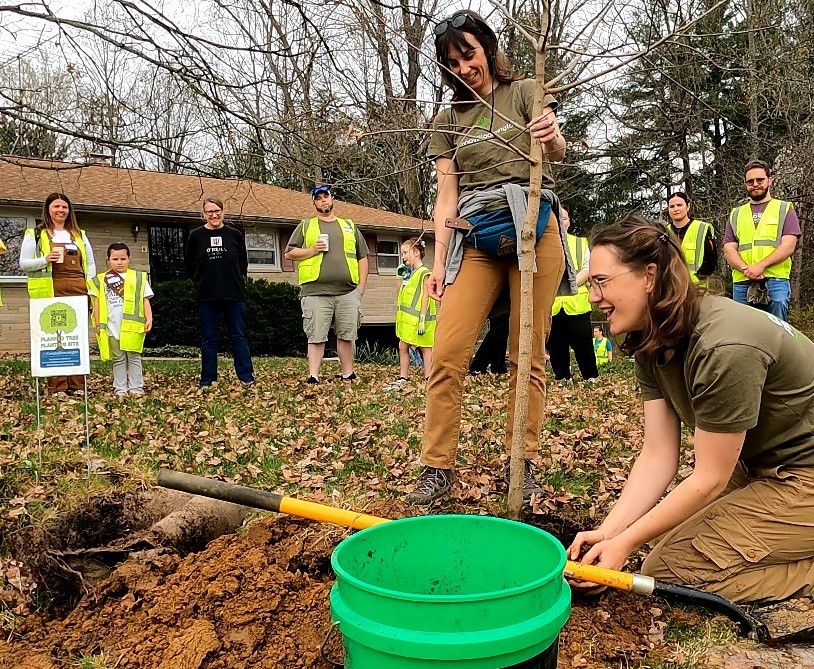
A group of volunteers gathers on a leaf-covered lawn for a community tree-planting event. In the foreground, a woman kneels to steady a young sapling in a dug hole next to a bright green bucket and shovel.

January 2025- Fischer's annual guest lecture and discussion- E555- Sustaining Urban Ecosystems

Burney Fischer annually gives a short lecture and then leads a discussion on urban patch dynamics and related topics to the O’Neil SPEA E555 course Sustaining Urban Ecosystems.  A three-page pre-session description of patch dynamics and a few associated articles are the prework for the students who then develop a discussion question that is submitted to the instructor ahead of time.  The presentation covers introductory thinking about urban patches – from both a social (neighborhoods) and ecological (urban forested patches) perspectives.  The presentation closes with a review of redlining and the Moxley and Fischer research paper “Historic HOLC Redlining in Indianapolis and the Legacy of Environmental Impacts.”  The discussion focuses on redlining and its ecological and social-ecological impacts on cities and as well as how urban greening nonprofits might address this long-standing legacy to improve the environmental condition and human health of those living in impacted areas. 

Two side-by-side maps of Indianapolis, labeled (a) and (b), illustrate historical redlining districts color-coded by risk assessment. Map (a) plots numerous brown square markers concentrated primarily near the city center, while map (b) features a cluster of black star icons located on the southwest side.
A redlining color code key displaying four graded evaluation levels alongside their descriptive text. The blocks are stacked vertically, showing red for "Hazardous", yellow for "Definitely Declining", light blue for "Still Desirable", and green for "Best".

December 2024- Jess Vogt, former BUFRG graduate student, publishes major article in Arboriculture & Urban Forestry

Jess Vogt, Associate Professor at DePaul University and Lead for the Lab for Urban Forestry in the Anthropocene (LUFA) has published a major article “A Comprehensive Framework for Understanding Urban Forests as Social-Ecological Systems” in Arboriculture & Urban Forestry 2024. 50(6):427–469

The article first explains the logic of using frameworks and then reviews specific frameworks that  are applied within urban forestry.  It presents the urban forest social-ecological system (UFSES) framework. The UFSES framework specifies five first-tier factors: 1) the Characteristics of Trees in the Urban Forest (T); 2) the Surrounding Growing Environment (E); 3) Management & Institutions (M); and 4) Characteristics of the Human Community (H); which influence 5) Urban Forest Outcomes (O). A detailed set of second-, third-, and fourth-tier variables nested within these factors are presented in tables within the paper. The framework should foster holistic systems thinking in a systematic yet flexible way; provide a working draft of a common language for thinking about and studying urban forest systems; and enable comparative case research.

Within the paper Jess gives credit to her experiences at Indiana University as a graduate student with the following:

“ The first version of the urban forest SES perspective was published while I was in graduate school conducting research on planted trees with fellow Ph.D. student Sarah Mincey under the guidance of our advisor Dr. Burney Fischer with the Bloomington Urban Forestry Research Group (BUFRG) at the Ostrom Workshop at Indiana University. The BUFRG urban forest SES perspective (SES1 in Table 2) (Vogt and Fischer 2014) was an explicit combination of the Ostrom SES (Ostrom 2009) (see also Appendix A), Clark et al. (1997) (see also Appendix B), and an understanding of tree physiology (Kozlowski and Pallardy 1997). The SES1 perspective was applied quantitatively to data collected on trees planted by Keep Indianapolis Beautiful, Inc., revealing that the full complex SES variables predicted tree outcomes (survival and growth) better than models that excluded any of the SES components (Vogt et al. 2015d).”

An example from the article is the figure on the left, A simple version of the urban forest social-ecological systems (UFSES) framework, which should be recognizable by everyone associated with BUFRG and the Ostrom Workshop.


A conceptual diagram illustrating a framework for urban forest dynamics, showing interactions between a biophysical subsystem, a human subsystem, and central urban forest outcomes. The entire system is influenced by an overarching "Broader Environmental Context" and an underlying "Larger Social, Economic, and Political Context."
A logo for "Hubbard County COLA" features a light blue sky above a purple lake scene bordered by a line of green evergreen trees. In the foreground, brown cattails stand on the left side of the frame, partially obscuring a large orange sun rising or setting behind the tree line.

Summer 2024- Extending the Knowledge Commons Concept to MN Lakes with Dr. Burney Fischer

The May meeting of the Hubbard County Coalition of Lake Associations (HCCOLA) monthly Board meeting featured Burney Fischer giving a talk “Exploring the Knowledge Commons of Lakes for Hubbard County.”  The HCCOLA has 31 Lake Associations and for their monthly board meetings, which are open to the public, they generally host an educational speaker for the first hour of the meeting.  During conversation with HCCOLA Executive Committee over this past winter discussing lakes as commons Burney was asked to expand on the ‘commons idea’ to expand thinking on how lakes may be managed. Please scroll down to read the abstract, and a white paper is linked here.


In the Great Lakes states it is common for lakeshore residents to self-organize into a lake association, particularly in the time of a perceived crisis. Generally, the crisis passes after a couple of years, but the lake association continues to function. These lake associations could be thought of as the start of collective action to governing a lake as a common but the terminology is unfamiliar and rarely embraced by the residents. In fact, the uneasiness with the term governing is strong. Given this disregard for the practice of governanceit is interesting how much data about their lakes is accumulated over time and how this data becomes information and shared knowledge that is incorporated into decision-making about the lakes by the lake association, lake visitors, and local/state government. The presentation and draft paper are a first attempt to present to a coalition of lake associations how they influence the co-management of their lakes between lake associations, various government agencies and other interested partners through the wide array of knowledge they create and/or have access to.

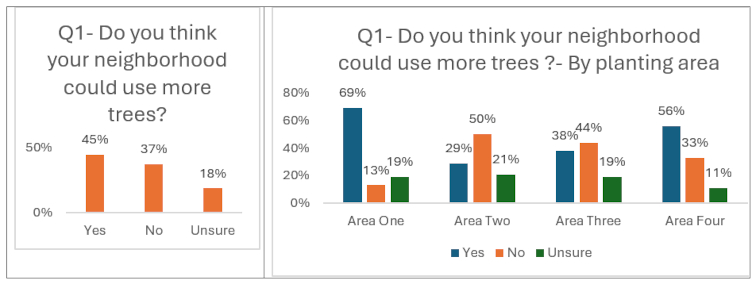
Two side-by-side bar charts display survey responses to the question, "Do you think your neighborhood could use more trees?". The left chart shows the total distribution of answers with 45% Yes, 37% No, and 18% Unsure, while the right chart breaks down those percentages across four specific planting areas.

February 2024- Full report released of tree planting survey of Bloomington residents

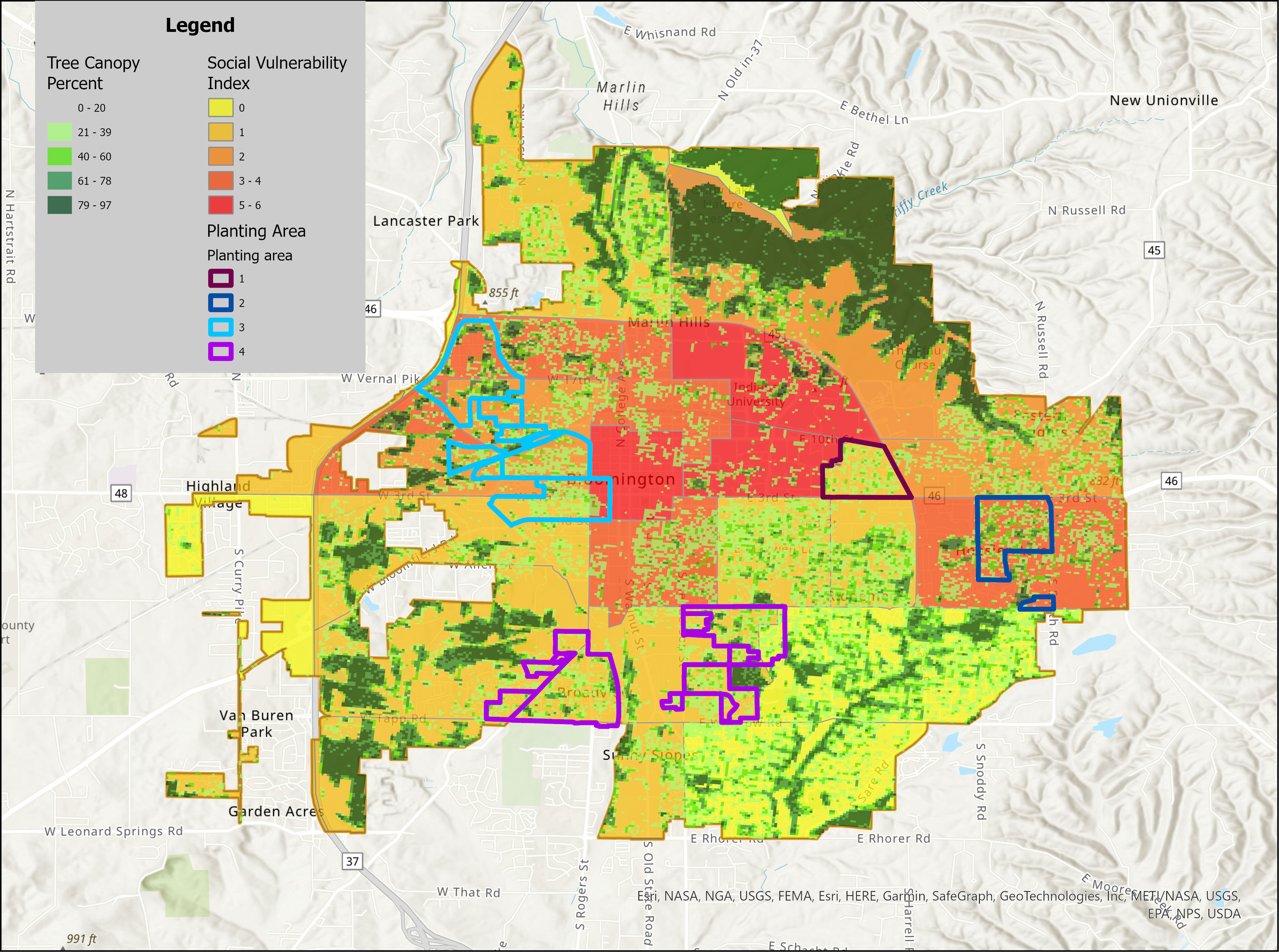
The analysis and write-up of the results of the post-planting survey of Bloomington residents has been completed. People living in neighborhoods selected for the first round of tree planting funded by the Bicentennial Bond were invited by mail to complete surveys reflecting their attitudes on and knowledge about urban forestry in Bloomington. The results are informative and can be found in the report linked here. The survey project will continue with a pre-planting survey of residents living in the newest selection of neighborhoods, expected during late summer/early fall 2024.